First, some basic definitions lest you be misled into thinking this post is about Mulder and Scully:
Gen-X–
English adj. & noun, “a term typically used to describe the generation of Americans born between 1965 and 1980”
Senex–
Latin adj., “old, aged, advanced in years;”
Latin noun, “an aged person, an old man, old woman (from the latter half of the fortieth year onward)”
File–
English verb, ‘“place (papers) in consecutive order for future reference,” mid-15c., from Old French filer “to string documents on a thread or wire for preservation or reference” (15c.), earlier “to spin thread,” from fil “thread, string” (12c.), from Latin filum “a thread, string; thread of fate; cord, filament,”;
English noun, “collection of papers systematically arranged for ready reference” is from 1620s; computer sense is from 1954”’
A birthdate in 1965 plopped me at the head of Gen X even as it plopped me on my bottom: I am a contrarian and entered the world butt first.
Despite American culture’s twisted perspective on youth and age, I’m willing to be labeled a “senex .” In fact, by Roman standards, I have merited that label for more than 20 years. You can take the fact that the Romans considered someone aged 40+ to be “old” as a sign of the low life expectancy that prevailed before the scientific advancements of the last century and more. So, senex I proudly am, though I lament the avalanche of decrepitude that tumbles me down the hill as months and years pass.
As to the Files, a “thread of fate” stretches from my birth to my career as a Latin teacher and now to a retirement that can pose more questions than it offers answers. I am currently thinking through another man’s answers as offered in files or documents from that man’s long-past life. The files are ancient letters. To be specific, they are letters written by Seneca (Lucius Annaeus Seneca), who was arenowned Roman educator, philosopher, political advisor, and tragedian (no, not the master-of-ceremonies character from The Hunger Games). The last decade+, marked by the popularization and marketing of Stoicism, has multiplied mention and quotation of Seneca, as well as the later Stoic figures Epictetus and his pupil, Marcus Aurelius. Frankly, I am quite dismissive of the modern ‘Stoic’ movement, marked as it is by memification, casual appropriation, and distortion by so-called influencers and YouTube life coaches. And yet in Seneca’s Epistulae ad Lucilium, a collection of letters that Seneca wrote in forced retirement to his former pupil, Lucilius, I find much that is worthy of preservation, and valuable for reference when considering ways to improve one’s thought processes and behavior. Sometimes the letters are called Epistulae Morales (Moral Letters) because they elevate the connection between thought processes and behaviors as determinants of one’s moral and mental state.
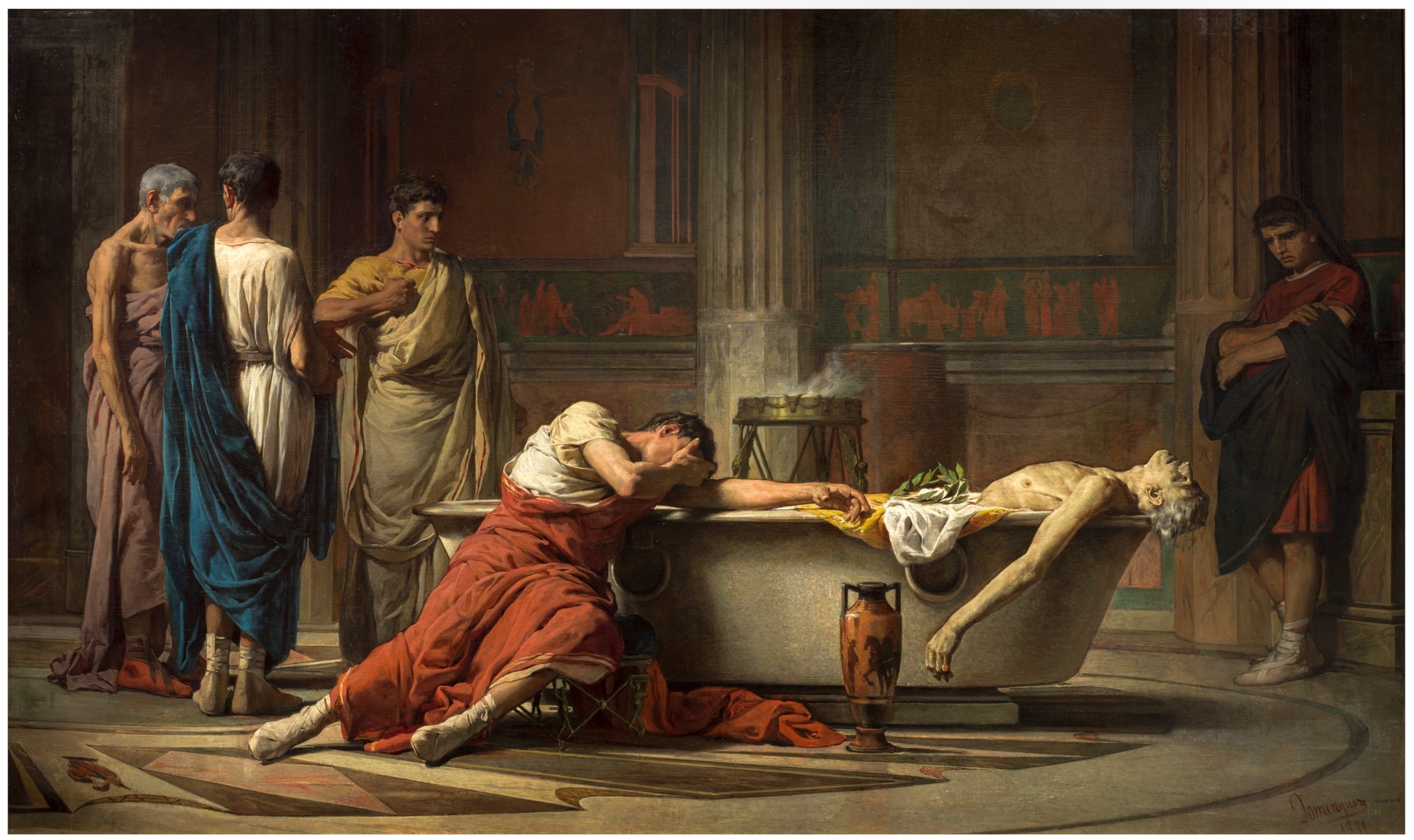
A bit about Seneca: he spent decades at or near the Roman Empire’s center of political gravity, having dealings both direct and indirect with Caligula, Claudius, and Nero (Rome’s third through fifth emperors). He was admired enough and hated enough by those men, their families, and other figures in Rome’s imperial court and political infrastructure that he was exiled, brought back, and installed within the palace power structure when Claudius made him tutor to Nero. Nero subsequently forced Seneca’s withdrawal from public life and, eventually, his former teacher’s withdrawal from life itself. (Rather than face the public execution imposed by Nero, Seneca effected his death at home—be forewarned that a depiction of that death appears below.). The opinions of historians (both contemporary and later) include details and viewpoints in their portrayals of Seneca’s life and death which range cross the spectrum from admiration to frank and deserved criticism. In one influential encyclopedia of classical civilization, the author concludes his biography of the philosopher:
“Seneca’s great misfortune was to have known Nero; and though we cannot say that he was a truly great or a truly good man, his character will not lose by comparison with that of many others who have been placed in equally difficult circumstances… Seneca’s fame rests on his numerous writings, which, with many faults, have also great merits.”
William Smith, Ll.D., A Dictionary of Greek and Roman Antiquities (1890)
The leisure of my semi-retirement (and the sense that I don’t yet have life figured out, by which I mean that I continue to appraise my life and improve how I live it) brought me to read and ponder the Letters to Lucilius as a collection of Seneca’s applied philosophical writings. By ‘applied’ I mean that the tenets of the letters apply to practical dimensions of daily life. While there are differences between ancient daily life and mine today, there are often common threads, ones that are worth giving a little tug. I am the epistulae in Latin, and think about them sometimes in English, sometimes in Latin. The Files that follow as my posts on this blog will be all in English, in the hopes that doing so will make several of the most worthwhile letters more accessible to modern readers.
There’s slim chance that many will read with interest. After all, these are posts coming from one old dude inspired by an ancient old dude whose very name means ‘old dude’. No kidding, the guy’s family name (Seneca) derives from senex. Be the chance of interest ever so slim, we old dudes must abide. And must read. And write.

 The PHurrowed Brow