A road trip, learning opportunities, an unanticipated climb and summit.
Getting on the road
“Ain’t nothing in rambling,” preaches Memphis Minnie. So, after her, does Lucinda Williams in her restyling of Minnie’s song of the troubles that abounded when she strayed far from home. I beg to differ with them, or rather, I would venture that the conditions of my rambling differ quite a bit from those that shaded their blues. At the very least, there’s little chance of diminishing the troubles that I *do* have if, like Minnie and Lucinda, I resolve to “get me a good man and, oooo Lord, settle down.”
Something worthwhile certainly appeared in my most recent rambling. After a late winter and spring that had filled me with preoccupation and, at times, the fatigue of fruitless efforts, I needed some delight. Long deliberations and negotiations regarding a lease for a wind energy project proposed for a parcel of farm ground were one source of preoccupation. Those negotiations are still unresolved after seven months. Oy.
It has been a while since I wrote about my farm work. I have outlines for several posts,
and I will finish and share them as duties permit.
If you missed my earlier farm posts, you can find the first one here.
A second consuming project was a commitment to urge along and participate in a complicated collaboration amongst educators in the Classics community. Though retired, remain active in the Colorado Classics Association and work with other great people to promote the study of Latin and Classics in Colorado. I envisioned that as a four-month project. Month ten of this project just began.
Counterbalancing those extra duties, in April I was most fortunate to enjoy a very fine trip with my nuclear family in to view eclipse totality. But even after that great trip, I felt the deep-dwelling push to get out and ramble down the road on my own. What is more, the rambling I had before me would allow me at last to see dear family (siblings, nieces, and their loved ones) in southern California. That visit was overdue and a long time in the making: last November, a blown tire on my motorcycle had caused me to abort the trip when I was a third of the way to San Diego. (There can indeed be disappointment in rambling!). Six months later as Memorial Day approached, I set out, this time by car, as I wanted to a) enjoy easy travel, and b) bring gear to enjoy activities both in California and along the way. Discs to play golf with my son in Gunnison, rod, reel, and tackle to fish in the Black Canyon, boots, daypack, and trekking poles for a planned hike with my niece in the San Jacinto Mountains above Palm Springs— these would not all fit in or on the side cases of my bike. So, on four wheels I happily set out, knowing that I had three fixed stops but planning to decide the rest of my route and explorations as I went. And on the return, I was content to let the uncertain start of wheat harvest draw nearer and clearer before I decided on a one-day or three-day homeward drive. However it might be that either end of the trip worked itself out, I was thrilled with its core, a week with family in my childhood home state, and the chance therewith “to rest my head tonight on a bed of California stars.”
Mountains in Arizona?
It’s still novel for me to be flexible when I travel, preferring as I do well-laid
plans to serendipity. But on this trip, it worked out well. My outbound route included hiking and fishing in the Black Canyon, then brought me through the sandstone wonders of Monument Valley, which (encompassing portions of Utah, Arizona, and the Navajo Nation) I have been fortunate to see before, but only at highway speeds. On this occasion, I was able to explore petroglyphs along the San Juan River and explore a bit of the Nation’s Tribal Park,
slowing down to take it in on foot and on a backcountry driving tour. The
enriching experiences there made me glad that I made those stops.
On prior trips to Monument Valley, I’d always left it by heading west toward Page, AZ, or the Grand Canyon. My prior visits allowed me to admire desert, canyons, valleys, rocky outcrops, rivers and reservoirs, but Arizona seemed to lack what I think of as high country. This time I found some as I carried not west but southward toward Flagstaff. Doing so gave me a sustained perspective on Arizona’s highest mountains. US Highway 89 carried me along the eastern edge of this range and on into Flagstaff (where I joined I-40 and carried on west to Kingman). The 90 or so minutes on Highway 89 became offered opportunity to consider those mountains and the scraps of snowy cover still upon them. I was impressed by their prominence and seeming lushness amidst so much desert terrain, and I began to want answers to some questions: their names, their altitudes, what significance do they hold in the cultures (ancient and modern) of Arizona. And could I find a suitable trail and conditions to hike in those mountains when I made my return from California? Life conditions had not allowed me to get out for a hike in months, and I was hungry for a chance to indulge my inclination to reach mountain summits.
What I learned, after the fact
Here follow the most interesting (to me) snippets of what I have learned about these mountains. First, the nature and names of the various peaks and the surrounding landscape and forests are complexly layered. According to the U.S. Geological Survey, they are part of a great volcanic field, once dominated by an immense stratovolcano whose remains (after either eruption or erosion) resulted the various named peaks which surround a large inner basin. Nearly a thousand years ago, Indigenous American residents of a nearby pueblo witnessed the last known eruption of another volcano (Sunset Crater) which lies east of the peaks at the edge of the larger volcanic field. (Interest piqued? You can read more about the geology of the region here). The record of habitation by Indigenous Americans reaches back millennia, and indeed the peaks hold a sacred place in the religious and practical lives of both the ancient inhabitants and their descendants today.
These mountains offer an attractive place to live, and not just for their scenery. Readers likely already understand that mountains, including these, have a climate (and thus create weather) that brings a greater abundance of water than is offered in the surrounding desert lands. Both the thundershowers that build in summer (and transform into streamflow) and the snows that fall and accumulate in winter (and then melt into streamflow) create favorable conditions for abundant and diverse types of flora and fauna, and for diverse human communities as well. Additionally, the porous volcanic that is widespread in and around the mountain basin favors water infiltration, leading to significant springs and subterranean groundwater.
Water makes the peaks a magnet for life and culture: they have distinct names in the languages of ten or more different Indigenous Peoples, from the Acoma to the Zuni People. The U.S. Forest Service has collected many of these ancient names here. And in a gesture to the importance of these peaks in the cultures of Indigenous Americans, the Forest Service has officially called the designated wilderness area that includes the peaks the Kachina Peaks Wilderness, after the Hopi People’s rain-bringing deities. Much later, Spanish Americans, missionaries of the Franciscan order, came to the area, settled, and began the project of converting Indigenous Americans. Honoring their patron saint, they gave the mountains the name Sierra de San Francisco. The name stuck and persists in the official USGS designation of the stratovolcano as San Fransisco Mountain and the collective name of its surviving prominent points as the San Franscisco Peaks. Today’s winter recreationalists may know them as the home of Snowbowl, one of Arizona’s best-known resorts for snowboarding and skiing.
The various peaks remaining from the prior volcano include the six highest points in Arizona, each more than eleven thousand feet tall. The tallest three (in ascending order) are:
- Fremont Peak (11, 969 ft.), named after the military man and explorer John Fremont whose expeditions kickstarted the U.S.’s westward expansion);
- Agassiz Peak (12,356 ft.), honoring Swiss-born Jean Louis Rodolphe Agassiz whose work as a natural scientist in the U.S. had a great impact in understanding glaciology and geological time (including the concept of Ice Ages), and;
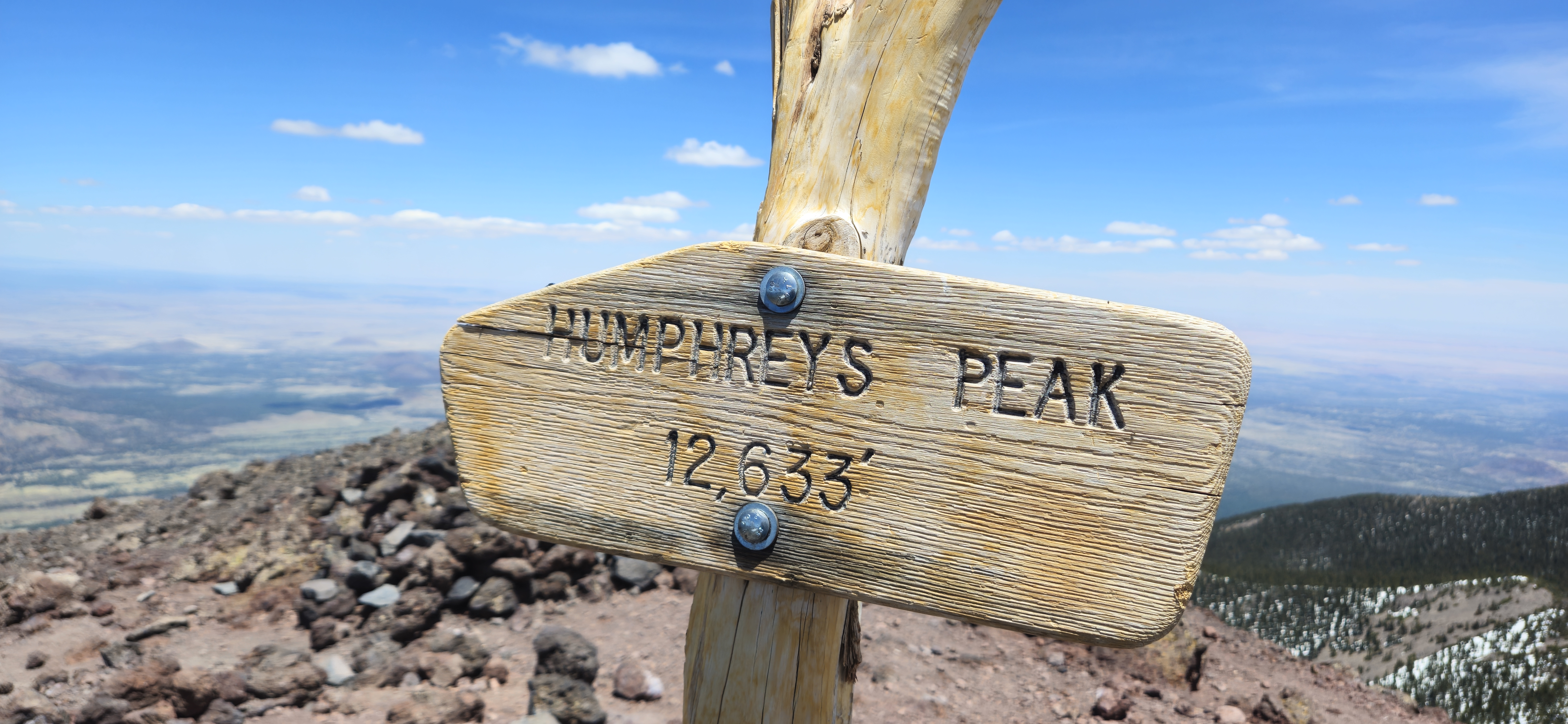
- Humphreys Peak (12,633 ft.), taking its name from explorer, general, and engineer Andew Atkinson Humphreys.
Humphreys had served as with the rank of Captain among the engineers who took part in the Ives Expedition of 1857-1858, navigating by steamboat from the delta of the Colorado River in Mexico to the mouth of the Black Canyon. Thus Humphreys had a large and direct impact on events that culminated in Arizona’s becoming a U.S. territory. Years later he had a nationally prominent roles in the Civil War, and eventually rose to command the U.S. Army Corps of Topographical Engineers where played an early role in the Corps’ work to promote navigation and prevent inundation along the Mississippi River.
These three figures are certainly standouts in the physical, intellectual, and technological expansion of the United States, and their eponymous peaks are fitting reminders of their accomplishments. The three lesser peaks are named with locals in mind. They memorialize prominent Euro-American settlers of the Arizona generally and the Flagstaff area, in particular. Most notable in lasting impact was recently immigrated Julius Aubineau, from whom Aubineau Peak (11,838 ft.) takes its name. Dwarfing the other services that he provided in the earliest days of Flagstaff, Aubineau pioneered a water delivery system that transferred that essential resource from the Peaks’ Inner Basin to supply the needs of the city’s residents and filed for the water rights that have allowed Flagstaff to grow in size and importance. One testimony is that the city hosts Arizona’s third largest public university.
Water, but not enough
Aubineau’s actions did not, however, solve all the water troubles of Flagstaff. And they contributed to problems for the Indigenous residents of the region. First and foremost, those actions deprived Indigenous Americans of waters that had been a birthright shared amongst numerous Peoples. Our nation just observed the 100th anniversary of the Indian Citizenship Act, which first universally recognized Indigenous Americans as U.S. citizens. (Even after the act, few Indigenous Americans enjoyed the full benefits of enfranchisement, as you can read here.) A full 30 years before the Indian Citizenship Act, Aubineau, who had emigrated from France, gained his U.S. citizenship after three years in Flagstaff, and four years later became mayor of that young city. (For more about Aubineau, expand the entry for Aubineau Peak on the USFS age for the peaks.)
Aubineau’s early work led to other expansive efforts to secure water rights for the city, both within the Inner Basin of the San Francisco Peaks and without. Nonetheless, as Flagstaff has grown (both as a home for its year-round residents and its students, and as a destination for tourists like me), the demands of the population, seasonal and long-term water scarcity, and inefficiency of water use remain matters of great concern. Indeed,the city has had to explore new and controversial methods of using and adding to its hydraulic resources. Controversy has dogged Snowbowl since it opened, but a decade ago, the city began using reclaimed wastewater in the snowmaking operations on the slopes, overriding objections based upon both environmental and religious concerns. And after recent years of devastating drought and as supplies from the Inner Basin dwindle, Flagstaff has resorted to digging wells to tap into the groundwater in its front yard. Even now, the city administration is trying to build support for adding/blending highly purified reclaimed wastewater back into its freshwater sources and reservoirs.
You may wonder why I went down this rabbit…, er, sinkhole.
My interest in hydrology (and history!) is not incidental to my visit to Arizona. Indeed, my home in Colorado and my work with the farmers of western Kansas demand that I pay attention to both. Consequently, in May (just before this trip!) I had acquired an encyclopedic field guide to water in the American West for the layperson, and I’ve since finished it. I highly recommend it to you, both for its utility and its breadth:
Crifasi, Robert R. Western Water A-to-Z: The History, Nature, and Culture of a Vanishing Resource.
University Press of Colorado, 2023.
From what I read to what I saw
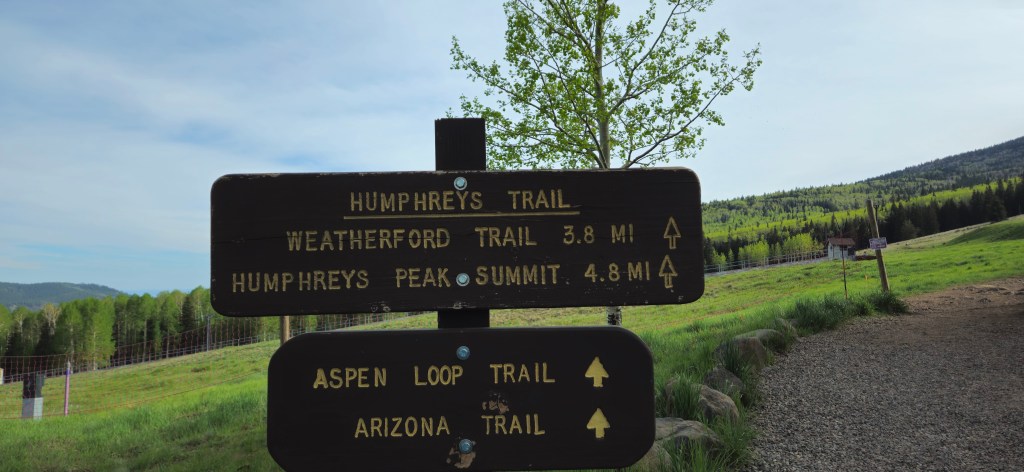
Back to my trip, the sustained peek I had at these mountains as I drove past them stuck in my mind. At intervals on the rest of my drive to California and idle moments there, I read up on the mountains, particularly the tallest peak, Humphrey’s. And the maturation of the wheat in Kansas slowed down enough for me to plan on making Humphrey’s my “sneak peak,” my unanticipated first summit of 2024. Humphrey’s has a pretty well-defined trail up it (“strenuous”, roughly 10 miles, with a 3,420-ft. gain in elevation, according to the Forest Service). Trip reports on hiking apps relayed that much of the winter’s snow had melted, leaving fields which were passable, especially if one wore microspikes for additional traction.
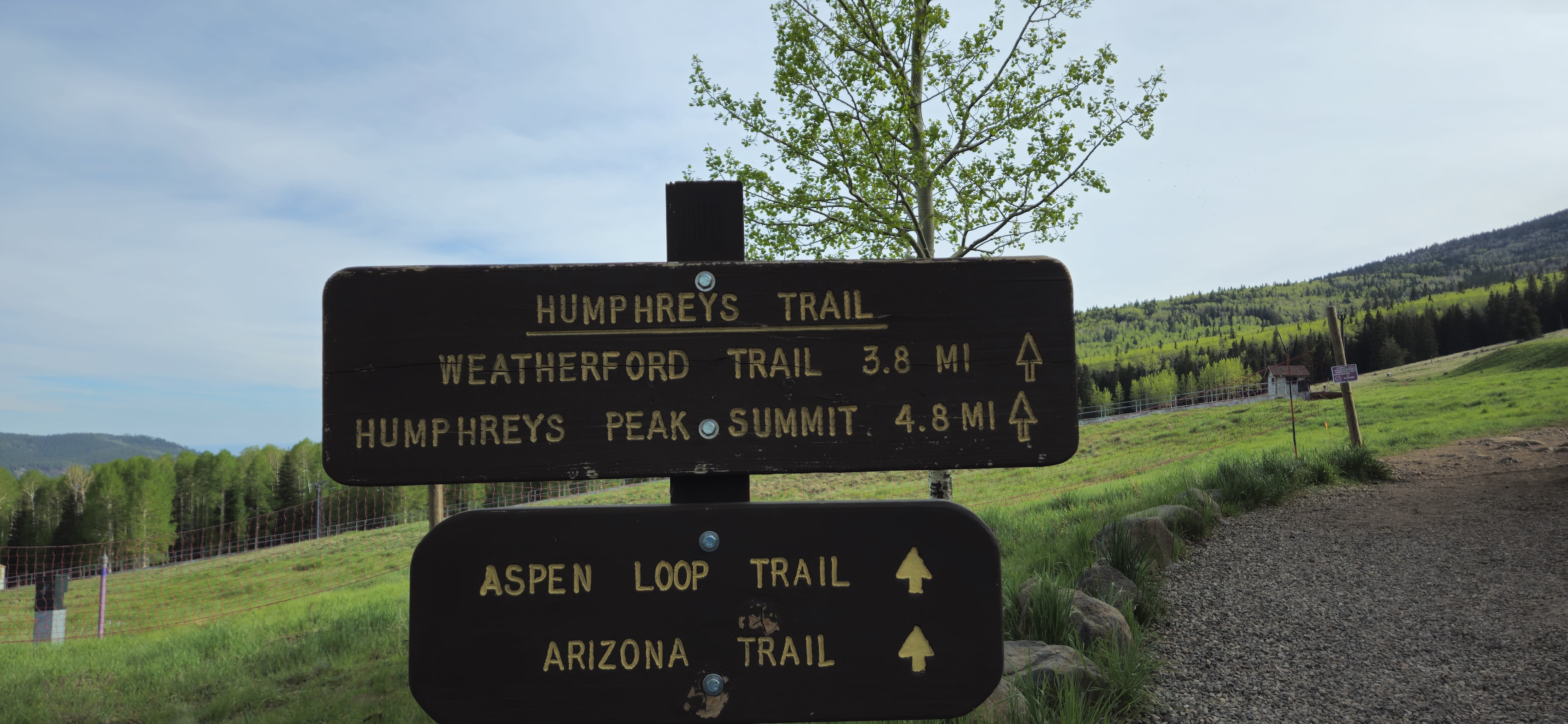
My spikes were resting in the comfort of the garage at home, so I stopped at the REI location in Flagstaff on my return trip. A helpful employee steered me toward their offerings and we chatted about the Humphreys Peak Trail. He indicated that I wouldn’t find much snow and that “in another week, it will all be gone.” I bought the spikes anyway.
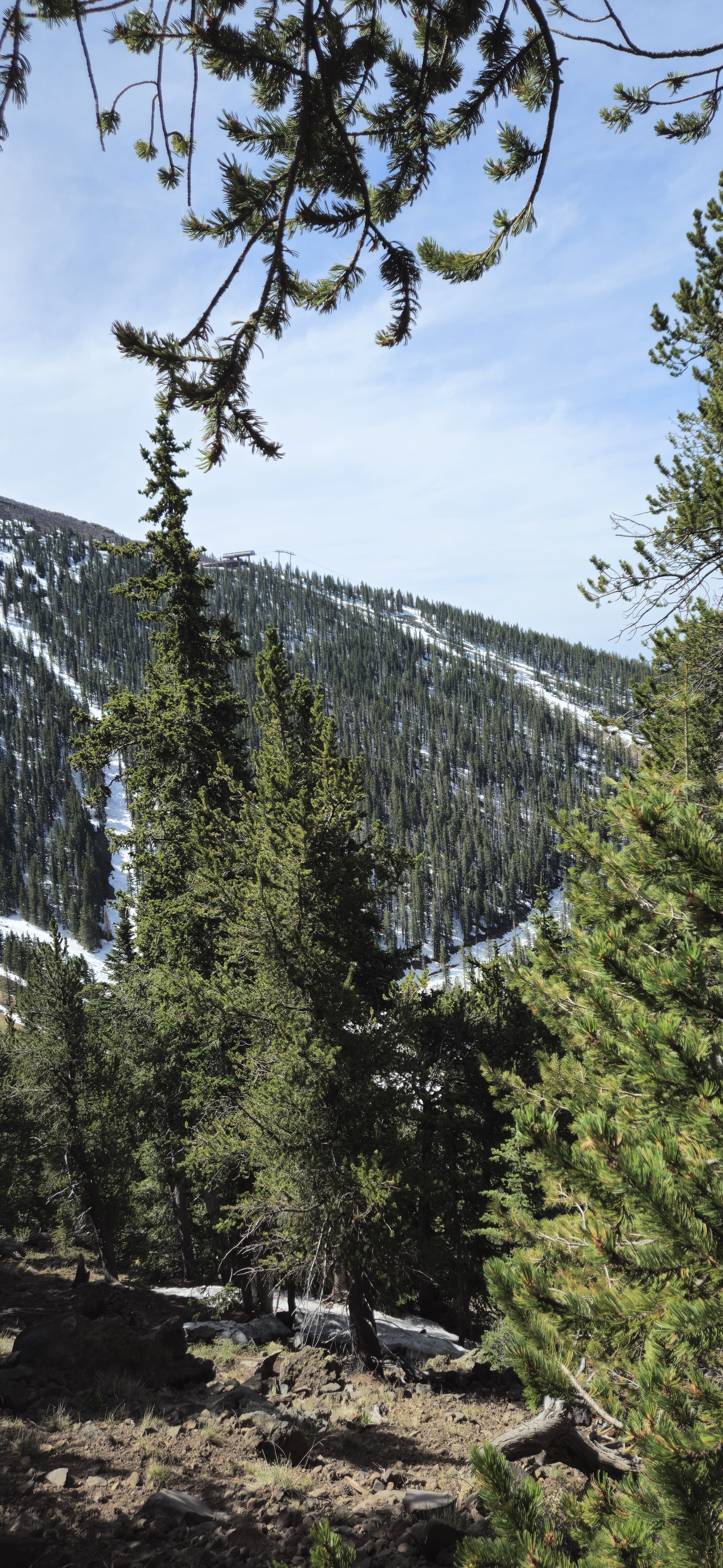
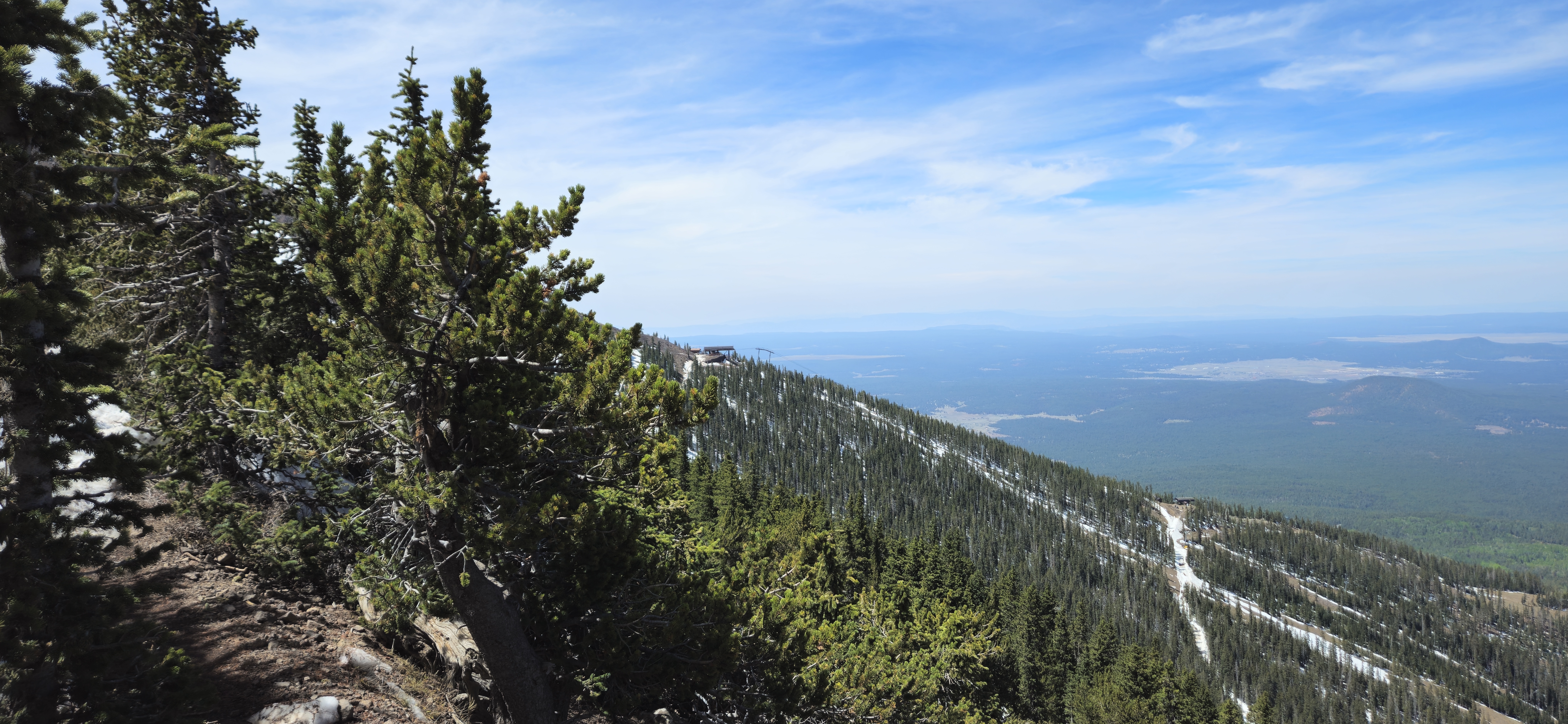
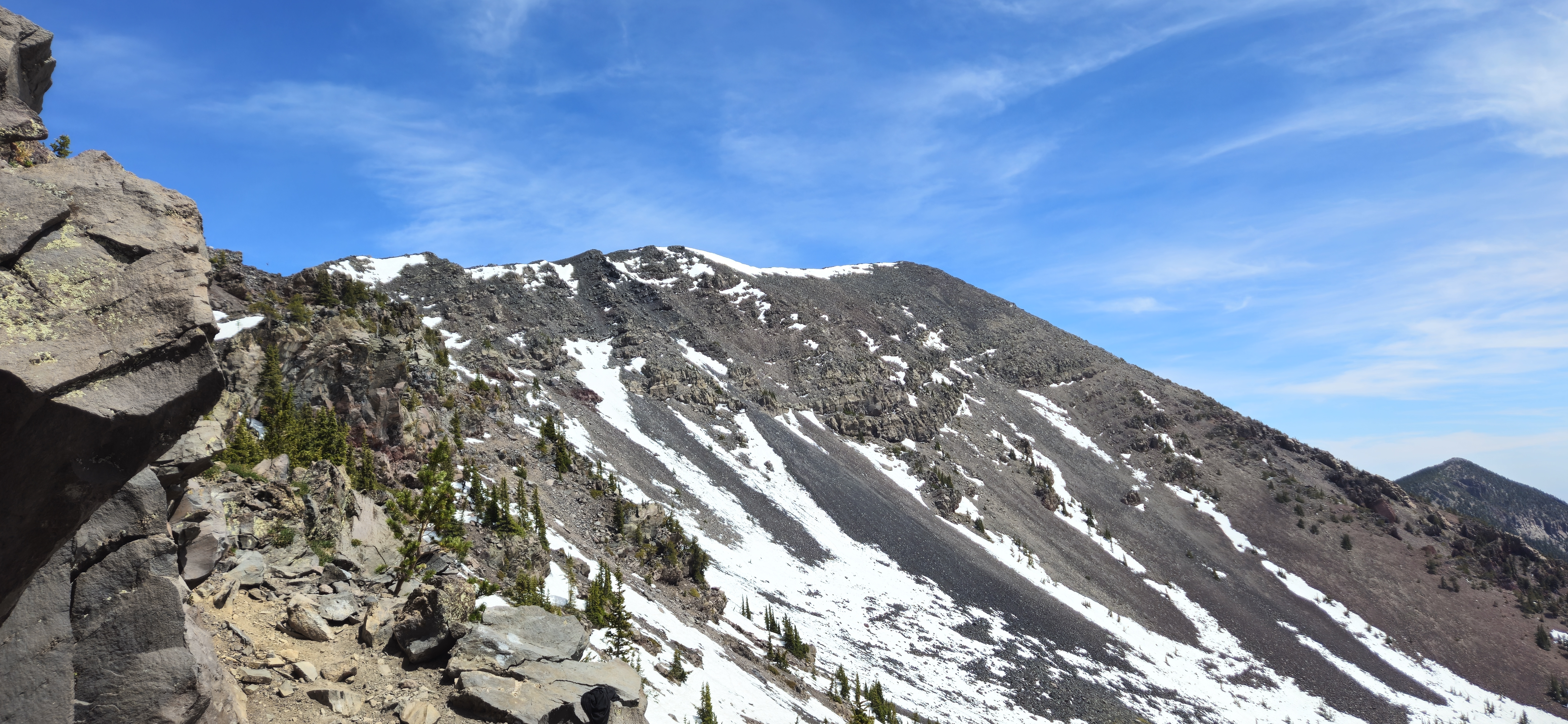
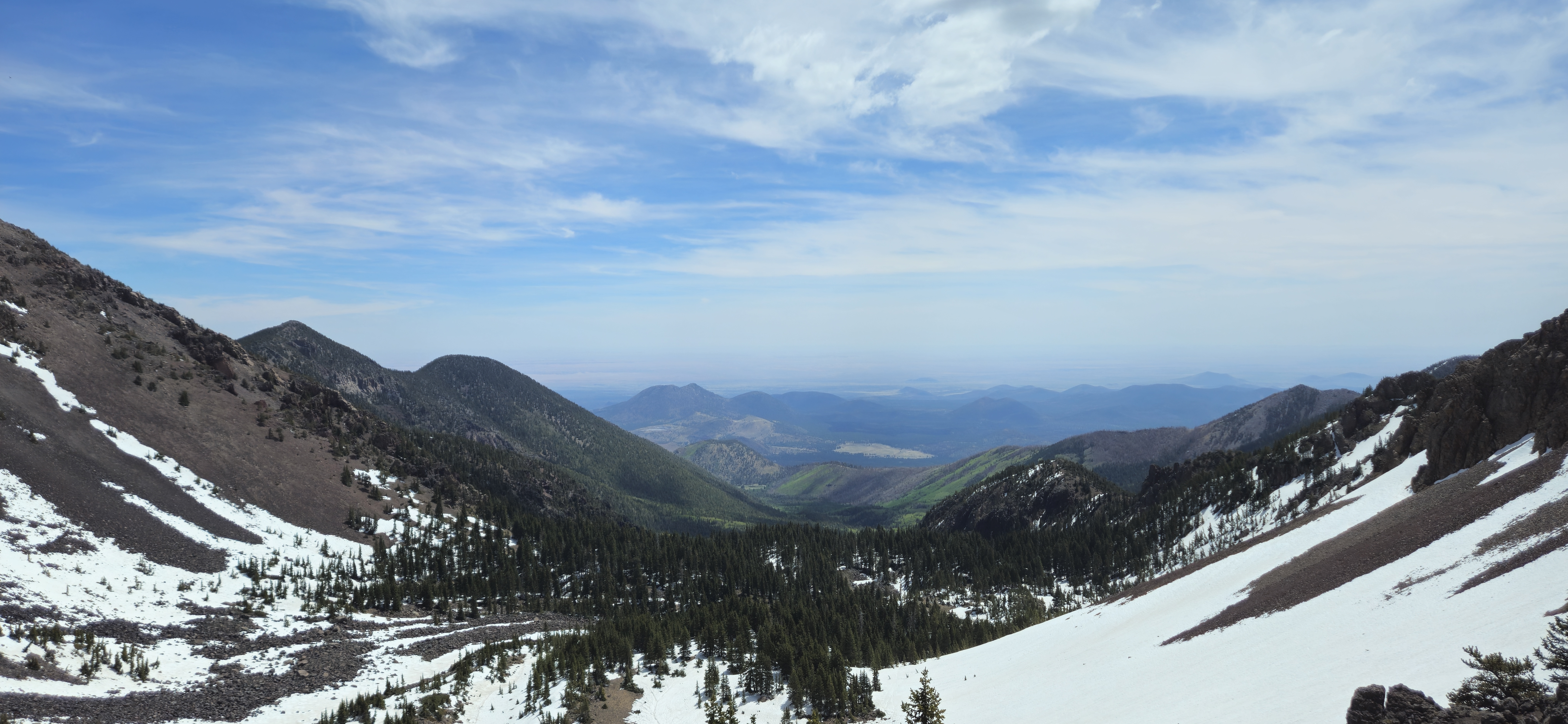
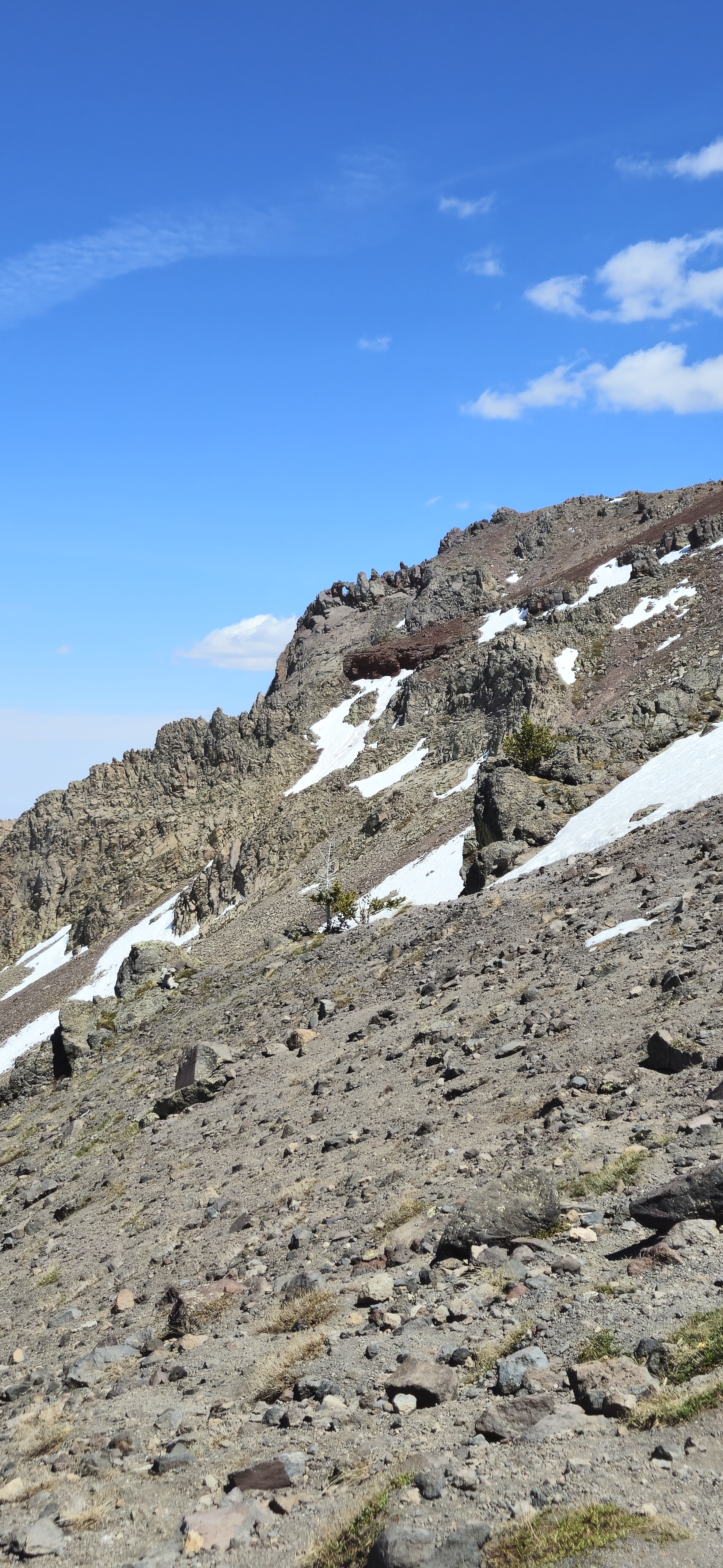
It was good that I did, as the snow fields were numerous and thick, spread over more than two miles on sections of the trail well-shaded by trees. The fields were usually off-camber, regularly steep on ascent and descent, and often on portions of the trail where there was a stark downhill slope. The spikes were for me essential, and though I was far slower than I hoped, I made it to the top and back down with only minor slips and slides. It gave me some comfort to know that the snow I fell into was natural (if not pristine), as the reclaimed wastewater sprayed in Snowbowl’s artificial snow operations is over on the slopes of Agassiz Peak. I took more comfort (and my sore joints needed it!) from the landscape and its amazing views, and from the sense of accomplishment.
(A pro trip for the photo gallery: you can click on an image to enlarge it and view the caption.)

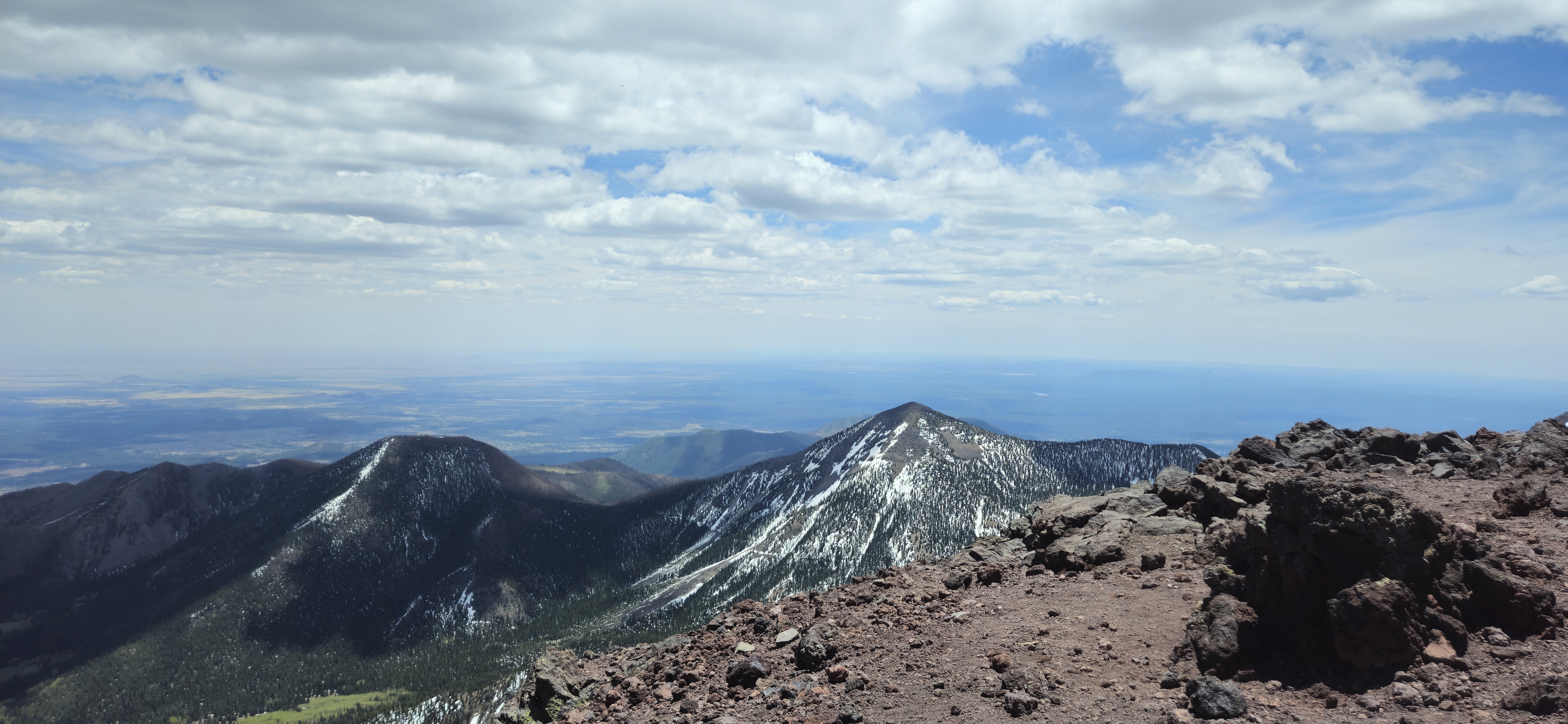
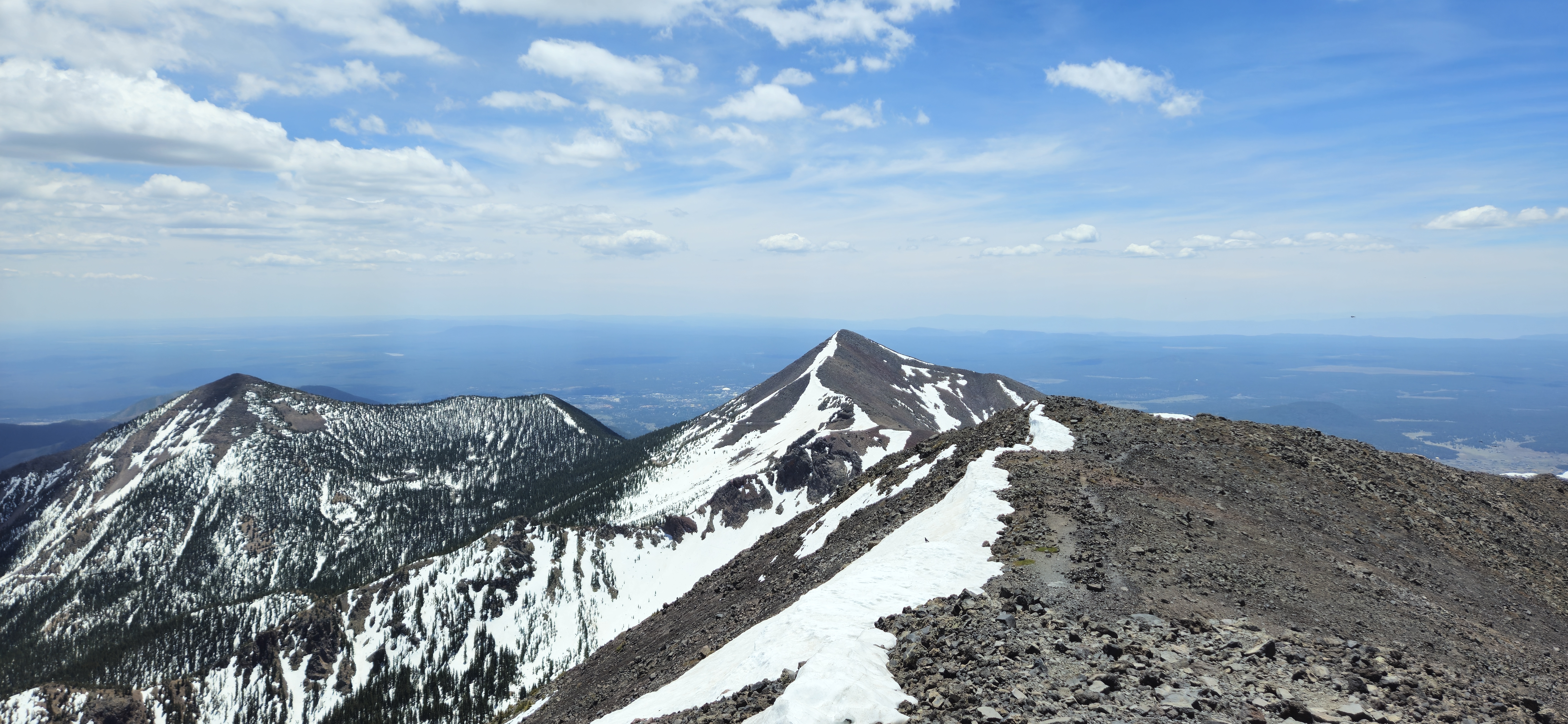
Truth is, though, that my good fortune is far greater than my persistence or stamina: so many don’t have the resources and freedom that allowed me to take this trip and to extend it for the hike. I’ll end this post where I began, with Memphis Minnie. Water is a joint throughline of her most famous song and much of this post. As is A.A. Humphreys and his efforts to shape America’s future through understanding its rivers. Minnie, you see, witnessed the devastating floods along the Mississippi and its tributaries in 1927. And Minnie, with her musical partner, Kansas Joe, sang of that time of fear and loss. Chances are you know of the song through its adaptation in the 70s by a certain British rock-and-roll band. Here’s the original recording, with images of the flood and its survivors.
 The PHurrowed Brow