This is the third post in a series, one daily from the 3rd to the 24th.
If you are coming to these posts late, I’d urge you (for continuity’s
sake!) to go back & read them in their sequence of publication.
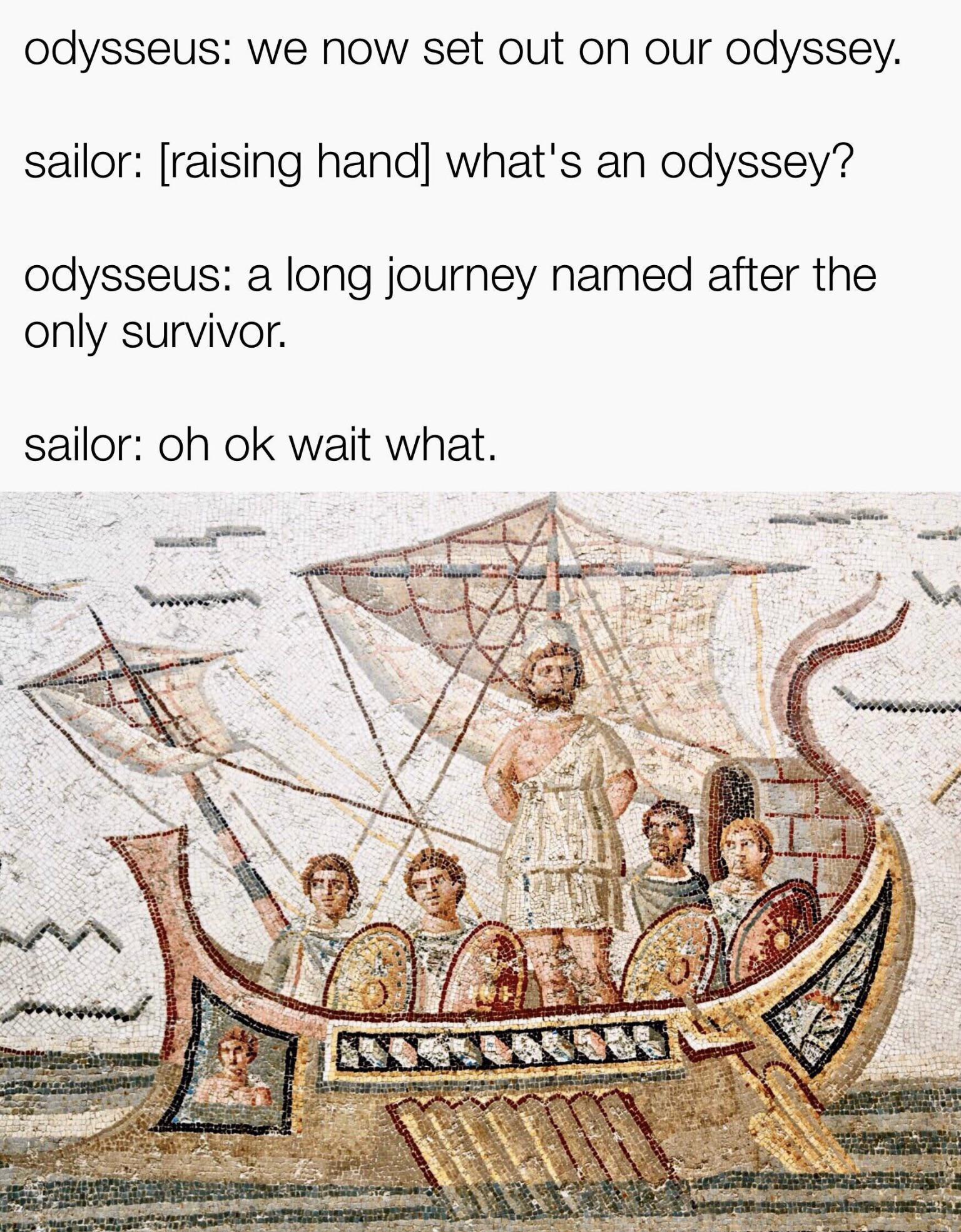
Centuries before Thomas à Kempis, Horace and Seneca, noble Romans both, published letters warning about travel. In truth, from as early as Homer’s epics, many ancient works, Greek and Roman alike, spotlighted the dangers of travel, especially travel by sea.
Other ancients, especially the poet Catullus, show a pleasure in travel and an excitement for exploration that seems almost similar enough to what I feel when I twist the throttle for a multi-day motorcycle odyssey.
The letters of Horace and Seneca, though, feature a rather different peril. In them, the authors argue that humans who travel bear with them the seeds of troubles that they’ll experience on their journeys. And so they each advise the recipients of their respective letters that travel will not solve their problems. In the Roman version of the “Wherever you go, there you are” trope, the addressee is presented as mistaking travel for transformation. Each addressee arrives at a failed transformation, and each author argues for a different methd that will enable the change that his addressee needs.
Horace, whose poetry swirls with an admixture of Epicurean, Stoic, and other ancient philosophical currents, was generally not a fan of long journeys. In his poem, cast as a letter to a friend, he advises against travel undertaken as a form of entertainment, a means of experiencing novelty, and a method of seeking status. Horace starts by diminishing the cachet that comes with being able to boast that he has seen so many famed and exotic locations in Greece and Asia Minor. He further adds that the grandeur of those destinations is not commensurate with inconveniences and dangers involved in seeking them. Indeed, Horace says, his friend will tire of those hardships long before it’s time to begin the return trip, predicting that the friend will suffer mid-journey regret for letting his restlessness and lack of contentment drive him from home. He tells the friend to glorify famous and exotic places all he wants, but to do so safely at his home in Ulubrae, just down the road from Rome. He concludes:
… those who rush across the sea change their
view of the sky, not their state of mind.
Exhausting idleness sets us going; by cruises and roadtrips we chase the good life. But what
you seek is here;
a life well lived is in Ulubrae, if your right state
of mind does not give out on you.
… caelum, non animum mutant, qui trans
mare currunt.
Strenua nos exercet inertia; navibus atque
quadrigis petimus bene vivere. Quod petis, hic
est,
est Ulubris, animus si te non deficit aequus.
Horace, Epistles I.xi.23-30, translation by the author
Clearly, Horace would not follow you on Instagram, nor would he ‘Like’ any of my boast-post travel photos on Facebook (q.v. infrā). To him, traveling in pursuit of some connection to distant beauty and glory functions as a substitute for building satisfaction in one’s self and in one’s own homelife. It is, he contends, an utterly inadequate substitute, one bound to breed discontentedness rather than the contentment that flows from a life well lived.
Yep, Horace’s message seems to be “Romans, stay home!” Of course, Romans inevitably roam, and there has to be someone besides Horace to correct that error. Thankfully, we’ve got Brian Cohen…
Horace’s poem ends before he offers an answer to this question: what must one do to live one’s life well, whether at home or on the road? For such an answer we turn to Seneca.
Writing approximately 75 years after Horace, Seneca the Younger was a teacher, Stoic philosopher, playwright, essayist, and imperial adviser. His writing offers what are to many some of the best-reasoned arguments for how to live life well, even in adverse circumstances. To me, his most effective pointers are given in a collection of letters which he wrote and sent to a former pupil named Lucilius. The bond of affection between Seneca and Lucilius make the letters come across like the wise and encouraging advice you’d seek from a skilled and trusted mentor. I.e., they are not sermons.
In the letter we’ll consider, Seneca seems to have received word from Lucilius: Lucilius, unhappy, has taken to traveling with the hope of finding happiness along the way. But he’s had no success and is now even more unhappy than when he set out. That’s no surprise to Seneca. Spoiler alert– you’ll hear several echoes of Horace’s language, as well as repetition of the “… there you are” motif. But you will also find that Seneca offers guidance as to how to live your life well, no matter where you are, no matter where your next stop may be:
Seneca sends greetings to his dear Lucilius.
Do you think that this has happened to you alone? And are you amazed, as if at something completely unheard of, that through such long adventuring and by visiting such numerous and varied places, that you have not dispelled your sad feelings and downheartedness? You need to change your state of mind, not your view of the sky. Sure, you may traverse the barren sea, and, as our great Vergil puts it, “The lands and cities may fall astern,” but wherever you have made landfall, your shortcomings will catch up with you.
Socrates spoke likewise to some fellow who was griping about his unhappiness: “Why are you surprised that adventures do you no good, when you are taking yourself along on the trip? The very same cause which drove you to travel weighs upon you as you go.” What help or pleasure can the novelty of other lands offer? What good is there in the experience of new cities or places? That sort of throwing yourself now here and now there is all for nothing. You want to know why that ‘escape’ brings you no relief? You flee with yourself as company. You must lay down the burden that is your state of mind: not before then will any place give you joy…
[Section 3 omitted]
But when you root out that troublesome burden, any and every change of place will become pleasant; you may be driven out to the ends of the earth, you may find yourself settled in some uncivilized spot, and yet that spot will be for you a most welcoming lodging. It matters more who you are when you arrive than where you come to, and for the same reason we must not surrender control of our state of mind to our mere location. Live by this conviction, “I was not born for just one corner of this earth,” my homeland is this entire world.”
[Part of section 5 omitted]
… Right now, you’re on no adventure; instead you drift and are driven, and so you change place for place, despite the fact that what you crave — to live life well– is offered you in every place.
[Sections 6-8 omitted]
It’s time to post this letter, but not before adding on a tip. “The start of recovery is the awareness of having done wrong.” Epicurus said this brilliantly, I think. For a person unaware that he is doing wrong is unwilling to be corrected; you must, so to speak, ‘catch yourself in the act’ before you can set yourself straight.
We all know people who show pride in their shortcomings; do you think that those who count their vices as virtues give any thought to curing themselves? For this reason (and as much as you can!), haul yourself into court, make yourself the subject of your own investigation; first perform the role of the prosecutor, then of the judge, becoming your own advocate last of all. At times go hard on yourself. Farewell!
Seneca Lucilio suo salutem.
Hoc tibi soli putas accidisse et admirans quasi rem novam, quod peregrinatione tam longa et tot locorum varietatibus non discussisti tristitiam gravitatemque mentis? Animum debes mutare, non caelum. Licet vastum traieceris mare, licet, ut ait Vergilius noster,
Terraeque urbesque recedant,
sequentur te, quocumque perveneris, vitia.
[2] Hoc idem querenti cuidam Socrates ait: ” Quid miraris nihil tibi peregrinationes prodesse, cum te circumferas? Premit te eadem causa, quae expulit.” Quid terrarum iuvare novitas potest ? Quid cognitio urbium aut locorum ? In inritum cedit ista iactatio. Quaeris quare te fuga ista non adiuvet ? Tecum fugis. Onus animi deponendum est; non ante tibi ullus placebit locus…
[4] At cum istud exemeris malum, omnis mutatio loci iucunda fiet; in ultimas expellaris terras licebit, in quolibet barbariae angulo conloceris, hospitalis tibi illa qualiscumque sedes erit. Magis quis veneris quam quo, interest, et ideo nulli loco addicere debemus animum. Cum hac persuasione vivendum est: ” Non sum uni angulo natus, patria mea totus hic mundus est.”
[5] … Nunc non peregrinaris, sed erras et ageris ac locum ex loco mutas, cum illud, quod quaeris, bene vivere, omni loco positum sit.
[9] Tempus est desinere, sed si prius portorium solvero. ” Initium est salutis notitia peccati.” Egregie mihi hoc dixisse videtur Epicurus. Nam qui peccare se nescit, corrigi non vult; deprehendas te oportet, antequam emendes.
[10] Quidam vitiis gloriantur; tu existimas aliquid de remedio cogitare, qui mala sua virtutum loco numerant ? Ideo quantum potes, te ipse coargue, inquire in te; accusatoris primum partibus fungere, deinde iudicis, novissime deprecatoris. Aliquando te offende. VALE.
Seneca, Moral Epistles to Lucilius XXVIII, translation by the author
Will this work? Speaking for myself, I do not have the capacity of Thomas à Kempis to adopt self-mortification and bear a metaphorical cross of suffering as a way to live well and merit a good afterlife. Nor, as Horace suggests, am I willing or able to simply stay home and somehow live life well by taking on a right state of mind. Rather, it strikes me as much more possible (though not easy) to scrutinize, assess, and seek to begin remedying my shortcomings. And. paradoxically, that essential first step of the remedy, i.e., simply grasping that I have failed to do right by others (or even to do right for myself), well, sometimes that awareness comes more readily when I am engaged in an what I’d call an adventure. I’m not talking about being mindful of and remedying my mediocre skills as a motorcyclist. Or vastly improving my geriatric pace when hiking. Or using desensitization theory to overcome acrophobia-induced vertigo.
To be as succinct as possible, being out and about adventuring provides two essential catalysts for awareness: 1) distance/decompressed space which allows me to look more objectively back at the troubles I carried with me to the present; 2) awe and gratitude for the beauty of nature and human culture, which allow me to recalibrate my state of mind. Therafter, if I successfully prepare for and persevere through challenges (both those that can be anticipated and those that are adventitions), I gain a model forgetting myself out of troubles I brought upon myself, and this model can serve as a modus deponendi, a method of laying down the burdens of fear, avoidance, and my other vices.
Don’t get me wrong, travel is also a great way to enjoy ‘the good life’: the nurturing novelty of finding new music, food, art or architecture, beautiful scenery, etc., as well enjoying all of the above when friends and/or family are part of your journey. Those are all worthy pleasures in and of themselves. But for me, adventure is more than travel and helps me to live life well, both when life is good and when it isn’t. Besides, a double-scoop ice cream cone does indeed taste sweeter when enjoyed after exerting oneself for hours on a steep climb or riding a tough trail. And who besides Horace doesn’t like a good boast-post on InstaSnapFaceX?
If you enjoy what you’ve read, please post a comment. Likewise, do so if you were troubled by it. Or use the Contact button to send me a private message. And to have you subscribe to the blog at the bottom of the page, well, I should like it of all things!
 The PHurrowed Brow
One response to “Romans, Stay Home!”
Tell Seneca that “Mark Twain wrote, ‘Travel is fatal to prejuidce, bigotry, and narrow-mindedness, and many of our people need it sorely on these accounts. Broad, wholesome, charitable views of men and things cannot be acquired by vegetating in one little corner of the earth all one’s lifetime.’ ”
(https://thesyracusejournal.com/opinions/travel-is-fatal-to-prejudice-bigotry-and-narrow-mindedness-so-is-returning-home#:~:text=Mark%20Twain%20wrote%2C%20“Travel%20is,the%20earth%20all%20one's%20lifetime.”)
I imagine your travels have broadened your mind and brought you great joy.
LikeLike