A treasure came my way at a library ‘decluttering’ event: I walked away with a copy of Romans & Aliens. Let me assure you that this is not some dubious History Channel pseudo-science DVD. It is, rather, a substantial scholarly volume by a former fellow of Oxford University, J.P.V.D Balsdon. The book collects and analyses an array of ancient source materials (from high literature to laws, legal documents, and epitaphs) to show the broad spectrum of views that Romans held about themselves as a distinct nation. As many nations still do, Romans often defined themselves by contrasts to others. Sometimes they cast those “others” variously as uncivilized, strange, slavish, foreign, and alien, though not of the extraterrestrial sort (sorry, History Channel fans). As I read Balsdon’s work, it gives me opportunity to reflect upon how Latin students progressing through our curriculum see the Romans alternately pushing away and embracing peoples considered as “others.”
The dynamic is very complex. From Rome’s earliest foundation legends we see them self-portray as refugees (survivors led by Aeneas fleeing the destruction of Troy) and as ready, if violently, to integrate aliens into Rome as fellow citizens (Sabines brought into Rome by Romulus, Albans by Rome’s 3rd king, Hostilius). Rome’s military might allowed her citizens to enslave non-Romans or to exploit them as non-citizen subjects. And yet the Roman history demonstrates that they engaged in a multi-layered interchange of culture and status with non-Romans: at times the Romans xenophobically despised and reviled the peoples of other nations, and at times they envied and craved other nations’ material or cultural wealth. Throughout the curriculum my students confront the truth of Horace’s famous dictum, “After it’s capture, Greece captivated its beastly conqueror and brought the arts into the Latins’ backward homeland.” In architecture, literature, science, and other areas, Rome made the genius of Greek “others” their own. In politics and civic life, the Romans for long periods jealously walled out others from Roman citizenship, and yet they periodically gave grants of citizenship to foreigners deemed worthy. Additionally, by the 1st century B.C. children born of former Roman-held slaves were granted citizenship. And in 212 A.D., Rome’s emperor issued an edict that granted citizenship to nearly all free residents of the Empire. By that time, the linguistic and cultural Romanization of peoples as diverse as the Celts of Gaul, the Turdetani of Spain, and the Dacians of Romania was well underway. And, of course, from the Latin spoken in those provinces, the Romance languages (French, Spanish, and Romanian, as well as Italian and Portuguese) developed after the Western Roman Empire’s collapse.
Linguistically, how do we choose to identify “others?” Most often we use derivatives of these Latin nouns and adjectives:
- peregrinus– this word is neutral in tone and applies to anyone (Roman or non-Roman) who travels and/or lives outside his/her homeland. This word contributes to English such derivatives as peregrination (e.g., the junior year of college I spent in Dublin was a peregrination) and the descriptor peregrine. Fun fact, the peregrine falcon is so named because it is so strikingly migratory and widespread, being found with minimal genetic variation across 6 continents. Paradoxically, this bird has traveled so widely that the world, not one region or continent, is its home.
- externus– this word is also a neutral descriptor and denotes a person or thing whose origin and nature is outside a nation’s borders. For example, the Romans called the Ocean on the western sides of Spain and France mare externum, the outer sea, to distinguish it from the nearly landlocked Mediterranean, which they variously called mare nostrum (our sea) or mare internum (the inner sea). People whose origins were outside the Empire, or concerns and beliefs that were not pertinent to or intrinsic to being a Roman were external. Related English derivatives such as external and extraneous show both senses. Fun fact, we also derive the English word strange (likewise, stranger and estranged) from externus, though changes in spelling and sound occurred when this Latin root passed through French (étrange) and Spanish (extraño).
- barbarus– there is nothing neutral about this descriptor, being reserved for people or things viewed as uncivilized, wild, or cruel. In a minor irony, Latin borrowed this word from Greek βάρβαρος. The Greeks used this term initially to describe foreign peoples whose language was unintelligible and sounded like a series of repeated nonsense syllables (bar-bar). The incomprehension of others’ language soon bred distaste for those others’ culture and values, as is evident from derivatives such as barbarian and barbaric.
- alienus– this last Latin word representing the concept of otherness is perhaps the most complex. The Romans used it most simply to mean “not one’s own,” both referring to people (e.g., a Parthian was not a Roman), to property (e.g., your neighbor’s house is not yours), and to behaviors (e.g., monotheism as a concept was alien to the Romans). In certain contexts, the word was stretched to mean “unfavorable,” as when, for example, a Roman army was forced to fight on ground not of its own choosing (somewhat the opposite of a modern sporting team’s home field advantage). Our derivatives alien, alienate, and alienation are frequently used with a similar tone and express a distance that is potentially harmful.
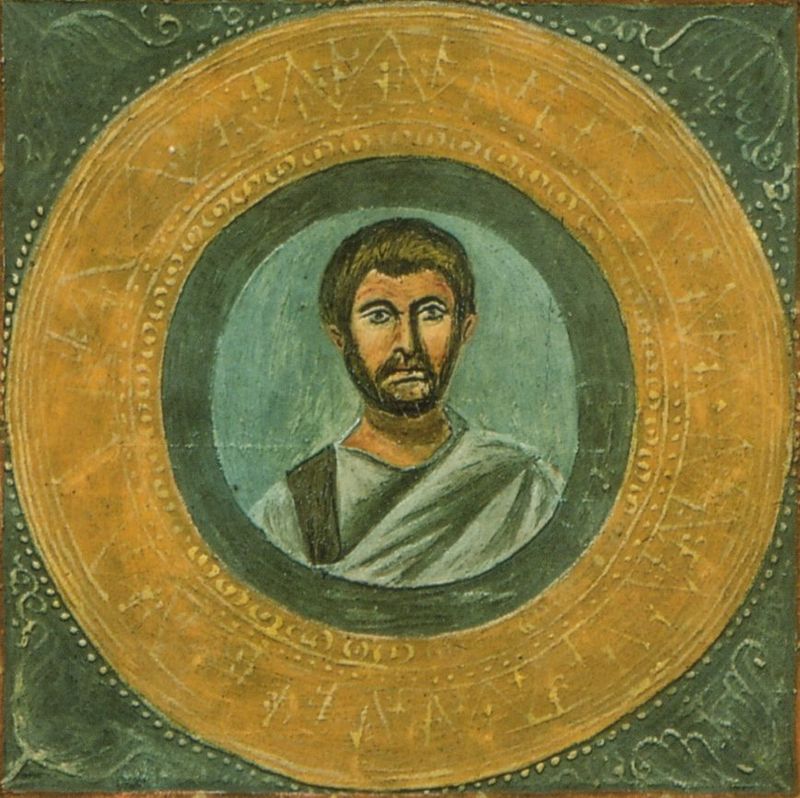
 Image of Terence in a Vatican manuscript, Courtesy of Wikimedia
If your patience permits, a long-famed quotation from the 2nd century B.C. Roman playwright Terence (himself a freed slave of Berber descent) may bring this discussion to a close: “Homo sum: humani nihil a me alienum puto.” “I am a human,” Terence’s character says, “I consider no human experience to be alien to me.” Later Romans such as Cicero, followed by Renaissance inheritors of Roman literature, embraced this sentence as an emblem of both intellectual and philosophical curiosity and as an assertion of human dignity that transcends national boundaries. This emblematic statement is part of a long tradition in Western education, one to which D’Evelyn (my school) proudly claims connection in its Founding Document when it quotes Jacques Barzun, “…what is the goal of such schooling? It is to turn out men and women who are not wide-eyed strangers in a world of wonders, but persons whose understanding of what they see makes them feel more at home in our inescapably double environment, natural and man-made” (Begin Here: The Forgotten Conditions of Teaching and Learning, p. 95, emphasis mine). It is only by seeking to comprehend and appraise what is foreign or “other” that students gain a functional understanding of themselves and how they may claim their home in this world. When our students encounter Latin (or another second language, and when read the rich literature and historical texts which are required elements of the curriculum, they, like the peregrine, can make the wider world their home.
 The PHurrowed Brow