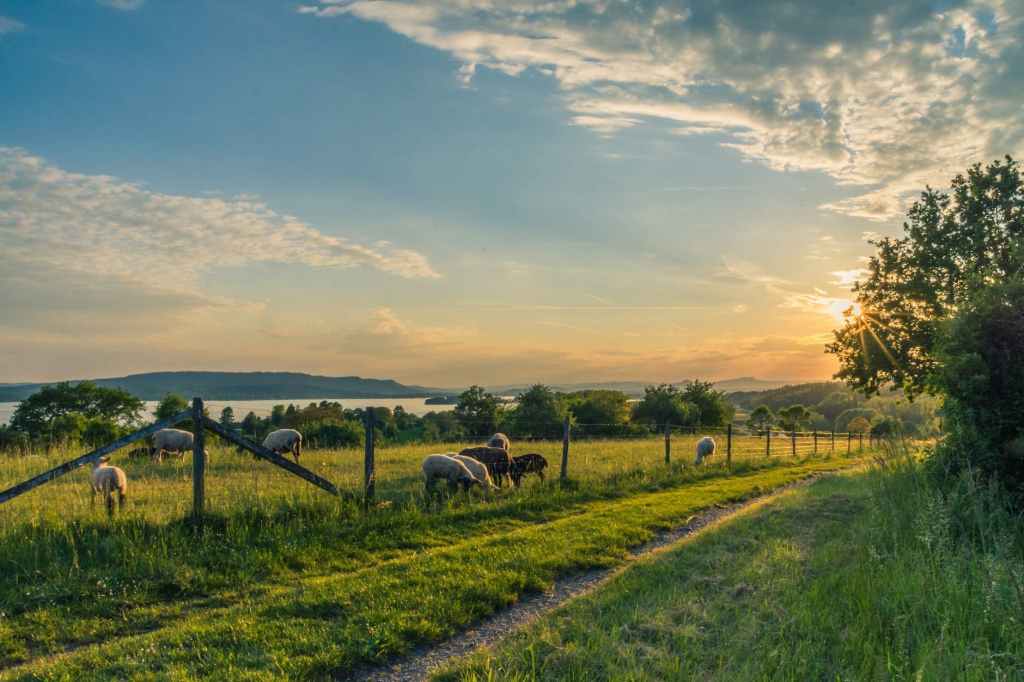
Recordatio Rusticationis Peractae
(Recollection of A Week Spent in Latin Country)
Hoc erat in votis: modus agri non ita magnus,
hortus ubi et tecto vicinus iugis aquae fons
et paulum silvae super his foret. auctius atque
di melius fecere. bene est. nil amplius oro,
Maia nate, nisi ut propria haec mihi munera faxis.
Horace, Sermones II.6.1-5
In my prayers I sought this: a measure of land none too big,
where there’d be a garden and, near my shelter, a steady spring and,
what’s more, a little piece of woodland. The gods have done me
something even grander and better. I am content. I seek nothing
further, Mercury, except that you grant me these gifts outright.
(author’s translation)
For a week this summer I knew such a longed-for sense of productive peace and experienced story-rich sodality as Horace describes in this satire (a work perhaps best known for its retelling of the fable of the country mouse and the city mouse). The god of travelers and gain had brought me safely to SALVI’s Rusticatio Omnibus at the Claymont Society‘s retreat house in the Shenandoah Valley. Therein this weary traveler of the Via Latina was refreshed and renewed in the company of thirty or so comrades. In Latin (and Latin only) we sang, strolled, played, argued, laughed, cooked, ate, learned, and taught over Latin readings, food, drink, and the verdant and wooded countryside. Inspired veterans and intrepid tirones (first-time Latin speakers) alike, we cultivated our minds, spirits, and tongues in a modus vivendi that left us changed for the better as teachers and scholars of all things Latin.
My reasons for making this journey were both personal and professional. As a teacher for more than a score of years I knew that my grammar- and translation-based mode of instruction did not serve all my students equally well: I did not offer or elicit sufficient oral or aural use of Latin for students whose learning strength does not spring from the printed page or lecture. Additionally, my school is on the verge of selecting a new Latin textbook for use in the decade ahead. My reticence and diffidence in my own capacity to speak Latin had also left me unwilling to go beyond simple, repetitive formulae, whether in the classroom or in my interactions with my fellow teachers. Of late, my nature has abhorred such a vacuum in my skills and my pedagogy. Therefore, after gratefully receiving both the encouragement of a colleague whose Latin program is thriving and the moral and financial support of my school’s administration, I rode off to a Latin adventure like none I had experienced before.
To some classicists, it might seem a Latin adventure of questionable worth. In traditional secular Western education, to be sure, there has long been a wall between oral and written Latin. From my earliest exposure to classical languages I had not considered the wall to be an impediment to my scholarship. In my pedagogy, too, I had been long content to maintain the line between quotidian pleasantries such as Quid agis hodie? (How are you doing today?) and the solemnities of “Arma virumque cano…” (I sing of arms and a man…). Rather like the speaker and his neighbor in Robert Frost’s “Mending Wall” it had been my manner as an instructor:
to walk the line
And set the wall between us once again.
We keep the wall between us as we go.
To each the boulders that have fallen to each.
Robert Frost, Mending Wall, 13-16
Put more prosaically, with my ultimate goal having been that my students read, understand, and intelligently discuss (in English) texts written centuries ago, I had not considered how their readiness to read and analyze Latin might be aided by the habits of speaking and thinking in Latin. Again, I knew that my method favored analytically-minded students over those who learn by authentic use. (By authentic use I mean the development of the capacity to have Latin at the genesis of spoken or written expression as opposed to translating an English thought into Latin before utterance.) And yet a time came when the existence of this wall and the work of maintaining it raised the question that eventually occupies the speaker in Frost’s poem:
Before I built a wall I’d ask to know
What I was walling in or walling out,
And to whom I was like to give offence.
Robert Frost, Mending Wall, 33-35
The answer, after my week at Claymont, is that I have given offence to all my students’ Latinity. My past students of a learn-through-use bent would likely have gone further than the required minimum in their Latin studies, and with greater joy in doing so. And those who, like me, analyze and categorize with facility and satisfaction, would have in no way been harmed by the additional capacity to engage in Latin discourse. Furthermore, to offer the simplest of examples, a student who has control of daily idioms through regular use is more readily able to read and understand the conversational quality of Roman letters as when, e.g. Cicero asks about the health of his best friend’s daughter, “Quid agit, obsecro te, nostra Attica?” (How, I beg you, is our dear Attica doing?, Epistulae ad Atticum XIII.15.2). On a more complex level, a student who has weighed the simplicity of an ablative absolute over the expansive capacities of a cum-clause when expressing something meaningful in her own words can more readily assess why Caesar chooses one structure here and the other structure there.
What specific benefits did I gain from this sojourn? Among the most consequential are these three:
1) my skills as a user of Latin (for reading and writing, as well as for speaking
and listening) grew tremendously;
2) I have found a generous and encouraging network of talented friends with
whom to maintain and grow my repertoire of instructional resources and practices;
3) my courage and capacities as a teacher (soon to be put to the test in the
classroom) were fortified and enriched in such a way that my teaching will be
more authentically Latin.
While still rich in written content, my instruction will more effectively foster student comprehension and use of Latin speech and text without a wall standing to divide them.
The validity of my assertion that I am a more skilled Latinist as a result of Rusticatio may lack objective proof, but in corroboration I offer a brief description of how our formal instructional sessions operated. A whole-group session began the day, usually offering a combination of demonstrations and implementations (semper Latine!) of vocabulary (e.g., words for bodies of water), grammar (e.g., contrary to fact conditionals), and/or literary-historical facts that were relevant to subsequent activities during the day. These activities effectively established a common baseline of understanding among participants who held Ph.D.s, and those who had not had a class in (or taught) Latin in decades. Participants who were needing explication got it. Participants ready for elaboration had the opportunity to offer it. Kind encouragement and correction were the norm, and I received both when I erred. This is the magic of Rusticatio, where erring is not a black spot or demerit, but is instead integral to the course of using Latin as a living, rather than as a scripted language. The point for me and my fellows was not to avoid error (as I might like before my students) but to convert analytical accuracy into practical communication, to strengthen both analytical and communicative competencies in the process.
Subsequent to the whole-group session, we would have two break-out sessions. The first would be a recitation to reinforce and expand upon the topic(s) covered earlier, while the second would a group reading and discussion (semper Latine!) of texts dating from Latin’s Golden Age to the Renaissance and afterwards. The first of these breakout sessions offered valuable opportunities to internalize language structures. The second session answered for me a key question: “Is there a productive way to use spoken Latin in the teaching, analysis, and explication of complex Latin texts?” The answer is absolutely affirmative. From simple matters such as guiding a participant to read the Latin with appropriate phrasing to re-ordering the Latin words into an Anglicized sequence to more focused parsing and grammatical analysis (when that was necessary), our facilitator created space for our group’s shared understanding of the Latin’s meaning. From that shared understanding, richer discussions attending to historical context, other authors, etc., naturally followed, just as they would have done had we been discussing the original text using English. Of course, our discussion was in Latin, removing seams and borders between text and interpretation. For me, at least, preparing to discuss the text in Latin led to a deeper, richer reading of the Latin text.
Communication in written or spoken Latin requires a community. Without willing interlocutors and readers, one cannot readily develop one’s communicative competencies. Participants in my SALVI program were engaged and engaging, diverse in backgrounds and talents, unstinting in encouragement and inventiveness. We thirty-some Latin speakers built a nurturing partnership during our retreat within our instructional sessions and in our recreation and leisure time, forming a sodality that allowed interchange of knowledge, teaching techniques, life experiences, and more. Conversations naturally extended to textbooks and lexica, online groups, blogs, and Latin chats via Google Hangouts, etc. In the days since leaving Claymont, I have begun to avail myself of these digital means of maintaining and expanding the community of which I became a part so that I can continue to have rich Latin discussions about literature and pedagogy. As an indication of how widespread this community is becoming, please note that my fellow rusticatores included Latinists from Australia and South Africa, and they are currently organizing retreats to be held in their countries in 2018. And for my Latinist friends here in the states, especially those in Colorado, don’t be surprised to see announcement on SALVI’s website (http://latin.org/) and the Colorado Classics Association email list of a Biduum (two-day retreat) here in our beautiful state before too long.
I don’t kid myself when I assert my goal of making my classroom instruction more authentically Latin. One week of immersion has not prepared me to guide a Latin discussion of Neptune’s rebuke to the winds in Aeneid I. Nonetheless I intend to take a stepped approach, starting in the coming year with my new Latin I students (despite our old, infelicitous textbook), implementing strategies to teach vocabulary and grammar, and to build students’ comprehension and production skills by letting them hear and speak authentic Latin. The following year, a new textbook will aid that process for that year’s Latin I students, while I step up my abilities to handle the more complex structures and content of my Latin 2 curriculum. And before I ride off into the teaching sunset, I shall fulfill my aspiration to have Latin interchanges with my students about literature and ideas that truly matter, just as Horace did with his guests and neighbors:
ergo
sermo oritur, non de villis domibusve alienis,
nec male necne Lepos saltet; sed, quod magis ad nos
pertinet et nescire malum est, agitamus, utrumne
divitiis homines an sint virtute beati,
quidve ad amicitias, usus rectumne, trahat nos
et quae sit natura boni summumque quid eius.
Horace, Sermones II.6.70-76
and so our
conversation picks up, not about other men’s villas or townhomes,
nor whether Gosling dances poorly, or not. Rather we debate that which
has greater meaning for us and which does us harm not to know: whether
humans become happy through riches or through virtue;
and what pulls us into friendships, benefits to be gained or
the quality of the other person; and what the essence of the good is,
and what the highest good may be.
(author’s translation)
Students who authentically use and comprehend the subjunctive in indirect questions will not need first to translate Horace’s reported conversation into English in order to understand it. And I can’t wait to hear their responses couched in glorious Latin indirect statements, “Puto naturam amicitiae esse…”
My purpose in composing this recordatio is simple: to convince you and my other readers that Latin lives in a community of speakers, a community of students, teachers, and professionals who have connected the dots between facility in oral use and improved capacities in reading and analysis. Those dots pass through a brain habituated by speech and written text to think in Latin, not a brain where the faculties of oral production and aural comprehension have been walled out. I needed convincing that this habituation was both possible and worthwhile. My week of Rusticatio gave me the evidence that I needed. Please let my attempt at sharing some dimensions of this experience convince you to seek out an event sponsored by SALVI (or by other entities such as The Paideia Institute) where Latin comes alive in the mouths, ears, and minds of those wanting to enhance their own Latinity and, perhaps, the Latinity of their students.
 The PHurrowed Brow