Please note that the following is a personal post regarding Jeffco’s compensation plan, not part of my normal column for the Jaguar Tracks.
January 3, 2016
Dear Members of the Board of Education,
Allow me to begin by expressing my appreciation for your dedication to the families of Jeffco Public Schools: after vigorous campaigning, you have openly and admirably begun the heavy lifting of study, dialogue, and governance. My hope, I would add, is that your experience and commitment will benefit our community greatly. My aim in writing is to seek your consideration of an ongoing issue of fairness in compensation. The issue is complicated, as it is the product of both an external factor (the Great Recession) and internal factors (decisions of past Boards first to suspend and then to cancel the prior system of advancing steps in the salary schedule). Some Board-made inequities have been rectified through litigation and negotiation (paying recent hires comparably to new hires and recognizing advanced degrees earned in academic disciplines), but there is another inequity that remains, and I seek to inform you of it and seek a commitment from you to remedy it.
The inequity arises from the interplay of three circumstances:
- The step-based salary schedule that was in place until its suspension in 2010 has “donut holes” in it. For a set period of years, varying by level, a licensed employee forgoes annual wage increases. Employees who remained in the district through this multi-year donut hole at the same level were “rewarded” with a larger-than-normal pay increase.
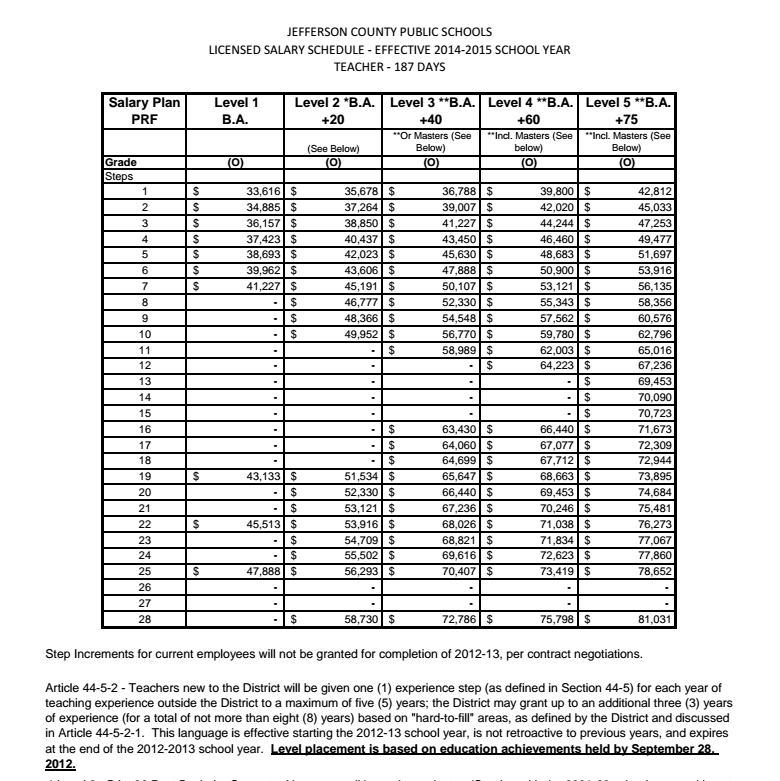
For example, my level (Level 3) on the scale has a four-year period (starting at Step 12) in which the salary ($59,989) was not increased. In the fifth year (Step 16) the salary was scheduled to increase to $63,430, a boost of 7.5% over the previous five years’ salary. When I hit Step 12, I looked forward to the far horizon of 2012 as the year when I would realize that nice gain in pay after years without one.
As a matter of record, Level 1 on the scale has a similar 11-year window; Level 2, an 8-year window, and Level 4 a 3-year window. A pasted image of the salary schedule is appended at the bottom of this letter for ease of reference.
While I note that there are many critics of a level- and step-based wage system. I will here neither assert nor deny the wisdom of such a salary schedule, but simply state that it was the existing instrument for employees to plan the compensation aspect of their careers, and with it the finances of their families. - The Great Recession’s impact was negative for education overall. For Jeffco licensed employees, it first meant pay freezes (no progress on steps), then cuts to workdays and correspondingly to salary, then eventually a restoration to pre-Recession salary. Everyone made sacrifices, and the district weathered the crisis with as small an effect on the classroom as possible.
I ask you to consider, though, that for some educators the impact upon wages was disproportionate. I will again use myself as an example, but would ask you to consider that I am likely to be one among many so affected. My Step 12 on Level 3 of the salary schedule fell in 2008, so I entered the donut hole as the economy went south. I anticipated no pay increase in the 2008, 2009, 2010, or 2011 academic years, for so the salary schedule dictated. My colleagues who were placed differently on the Level 3 schedule were able to enjoy their scheduled pay increases in 2008, 2009, and 2010, just as the Negotiated Agreement dictated. Then the effects of the Recession ended normal progression on the steps of the salary plan.
Using the salary schedules for academic years 2008-2013, I have assembled the following table to indicate the disproportionately adverse effect that the donut hole and the recession had on teachers in my situation. For purposes of comparison, all numbers below reflect an employee at Level 3 advancing a step each year until AY 2011.
| Step (Years of exp.) in AY 2008 | Salary in AY 2008 (+1 step & COLA) | Salary in AY 2009 (+1 Step & COLA) | Salary in AY 2010 (+1 Step) | Salary in AY 2011 | Salary in AY 2012 | Salary in AY 2013 (SALARY reset) | Net Salary Increase over 6 years |
| Step 9 | 54,008 | 56,770 | 58,989 | 57,219 | 57,219 | 58,989 | 19,146 |
| Step 12 | 58,405 | 58,989 | 58,989 | 57,219 | 57,219 | 58,989 | -620 |
| Step 15 | 58,405 | 63,430 | 64,060 | 62,578 | 62,578 | 64,060 | 24,681 |
As you can see, the combined factors of the donut hole and the great recession had a very disparate effect on the wage growth or, in reality, wage decline of teachers who might, but for the Recession, have exited the donut hole in 2011, 2012, or afterwards.
- The performance pay plan put into place by the previous Board majority compounded the disparity because it locked licensed staff into their 2010 salary for pay going forward in AY 2014 and this year. In essence, their plan locked me into a salary that was only $584 dollars more than what I earned seven years ago (AY 2008), while a Step 9 employee was locked into a wage $4,981 dollars greater than he or she earned in AY 2008. In the case of a Step 15 teacher, he or she would be paid going forward on a base that is $5,655 dollars greater than his or her 2008 salary. In other words, the disparities cited above were perpetuated in 2014-2015 and in the current school year.
I will mention that at two points I sought to bring this disparity to the attention of the previous Board. The first was an e-mail (forwarded below) on August 21, 2014. It received no response from the Board Secretary, Mr. Newkirk, and yet the Board majority voted very soon afterwards to adopt their scheme. I made a second effort to communicate the compensation disparity to the Board at Public Commentary at a May, 2015, meeting. Nothing I said seemed to make an impression, as they doubled down on the scheme, which means that again this year I am enjoying a base salary that is only $584 more than I earned in 2008.
When it comes to other inequities in the prior Board’s pay scheme, litigation and negotiation did yield some positive changes from year one to year two. Recent hires will no longer be leap-frogged by new hires, and educators who have secured advanced degrees in their fields will have their dedication and increased expertise compensated. I applaud the scrutiny and conversation that led to these concrete steps to value the commitment of those professionals more appropriately.
As far as I know, however, there has been no sustained effort on the part of district administrators, JCEA leadership, or you as our current Board to understand or correct the disparity in compensation increases for “donut-hole teachers.” Our plight is relatively easy to overlook, for we are not part of a readily identifiable class such as third-year teachers or Level 2 teachers who have freshly completed M.A. degrees. I hope that this letter provides convincing evidence that an inequity exists and should be remedied, whether through use of the underspent dollars which could be put back into the general fund (if COPs are issued for the Candelas project) or in negotiations on a new contract for 2016-2017 and beyond. As an individual employee, I lack the global perspective that you must have on funding matters, and yet I believe that so far only an individual teacher such as myself might notice that a greater-than-$20,000 disparity in compensation increases has occurred. It is within your power to remedy such an inequity.
I believe that the critical first step in determining a remedy is quantifying how many current Jeffco teachers have been affected by the donut-hole inequity, as well as quantifying the dollar disparities which have harmed loyal and effective Jeffco teachers such as myself. I ask that you collaborate with Superintendent McMinimee and Chief Human Resources Officer Weber to investigate the extent of the inequity through analysis of district employment records. I believe that their report of these numbers to you will offer the first glimpse of the true scope of this problem, and it is only with accurate data that you can determine what type of remedy is called for and what will be the best opportunity for it to affected teachers. They and I have not merited a base salary which is 1% higher than it was in 2008 while others enjoy a base salary that is more than 10% of what they earned in that year. In the meantime I thank you very much for your consideration of this long letter and eagerly await a response from Secretary Stevens.
Respectfully,
Pierre D. Habel
phabel@jeffco.k12.co.us
Attachment: 2013-2014 Licensed Teacher Salary Schedule
Forwarded email of August 21, 2014
CC: Chief Human Resources Officer Weber
JCEA President John Ford
Forwarded e-mail from August 21, 2014 follows:
From: Habel Pierre D
Sent: Thursday, August 21, 2014 10:25 PM
To: Witt Ken; Newkirk John; Fellman Jill; Dahlkemper Lesley; Williams Julie
Cc: McMinimee Dan M
Subject: Fact finding, compensation, valuing people
Esteemed Members of the Board of Education,
Let me first thank you for your willingness to volunteer your time, energy, expertise, and passion in the service of our district’s citizens and their students. While you may differ in perspective and priorities, I hope that this year brings increased opportunity to find common ground that advances the education of kids, increases the confidence of parents, and restores a sense of solidarity and institutional pride in my fellow employees. I trust that your dedication will make such positive change happen.
I am writing as a Jeffco teacher and the parent of a 2014 Jeffco graduate. I have a somewhat unique perspective on the district, one that I have developed in my 18 years in Jeffco. I am currently Jeffco’s only non-charter Latin teacher. I teach at D’Evelyn, a Choice school that is blessed with a high degree of positive parental involvement, students who come to school able and ready to advance their knowledge and skills, and a well-defined sense of mission with the means to fulfill that mission. I am in my third year of service on D’Evelyn’s Steering Committee, a unique volunteer body of parents, teachers, and principal who together shepherd our cherished Liberal Arts curriculum and whole-group instructional methods. I don’t want you to think, however, that my unique situation and perspective minimize my mindset and orientation as a Jeffco teacher. I value my school and my district very highly.
If possible, then, please read these words as representative of an ordinary Jeffco teacher. I am sure that I do not fully understand the purposes that motivated the decision not to accept the tentative agreement advanced to the Board last year. I listened to the Board meeting at which three members voted to move to the fact-finding process which, alas, continues. I did hear concerns about giving a salary increase to teachers rated as Partially Effective. I also heard a concern that the current salary structure contains a sort of donut hole of static compensation into which teachers rated Effective and Highly Effective fall. I did not hear a compelling, coherent statement that, to my mind, justifies creating a potentially yearlong salary limbo for each and every teacher. I am willing nonetheless to listen in the future as the Board discusses possible long-term changes to compensation and other structures.
At this time, however, I respectfully ask you to consider immediate action seeking agreement with JCEA to create a two-year agreement on compensation. I have multiple reasons for doing so: 1) I believe that in the first year of a new and newly comprehensive, data-based rating system, those rated as Partially Effective must be given a fair chance to grow towards a higher rating; 2) institutional change is not advanced by suspending the game plan and, indeed, the rules of the game when your team is on the field–such a suspension promotes a sense of chaos, not meaningful change accomplished through careful leadership; 3) fundamental fairness and balance can restore employee belief in a key Jeffco value: Valuing People.
If you will read one more brief paragraph, I will illustrate one effect of the decision to postpone agreement on compensation. Fully aware of the nature of the salary schedule, I entered the “donut hole” of static compensation in academic year 2008-2009 (my 12th year in the district). Per the salary schedule, I was set to exit the “donut hole” after four years (in AY 2012-2013). Of course no one connected to Jeffco can forget that district employees agreed to a multi-year salary freeze in response to the state’s fiscal difficulties. As economic conditions improved in 2013-2014, I and others who valued Jeffco students and families continued to receive the same salary. At the start of this static period I was able to plan for four years in the “donut hole” as it exists in the salary schedule. Next, I was able to hold out through the waning years of the financial crisis as the Colorado economy slowly began to wax into growth. In May of 2014 I was now six years without an increase, true, but at least in the seventh year I had the promise of a raise (nearly 10 %!). I literally counted on that money to aid my family, including my college-bound son. Now, however, as I spend my first week teaching an amazing group of Jeffco kids, I lack confidence that the organization that I value will show that it appropriately values my dedicated and effective work.
I relate my personal situation only so that you consider what other facts you may not know. How many other teachers were counting on coming out of the “donut hole” only to find that that hole’s diameter has been arbitrarily increased? Perhaps the HR Department will determine the number, if you ask. Will you weigh us against the number of teachers rated Partially Effective? I’m sure that Solomon could make a swift and effective decision as to how to settle what seem to be competing claims. Knowing, however, that we are a kingless organization, that it is not two individuals with competing claims, but a host of hardworking and dedicated employees in neighborhood schools and choice schools, I ask you please to come to swift agreement about extending the compensation plan outlined in the tentative agreement immediately and for a period of two years. I encourage you to focus right away on setting parameters to foster and measure how teachers move upwards from Partially Effective. Do, please, use that careful process to shape a revamped agreement for 2016 and to pursue the other important and challenging discussions that arise from your will, your learning, and the fact-finding process. But please consider first the unintended consequences of a Board-created pay freeze. Act now to undo it, I ask, so that my work is fairly valued.
Thank you for taking the time to read this. I shall be very glad to receive a response, including questions or opportunities for further communication.
Best,
Pierre D. Habel
Latin Teacher
Foreign Language Dept. Manager
D’Evelyn Jr./Sr. High School
 The PHurrowed Brow